
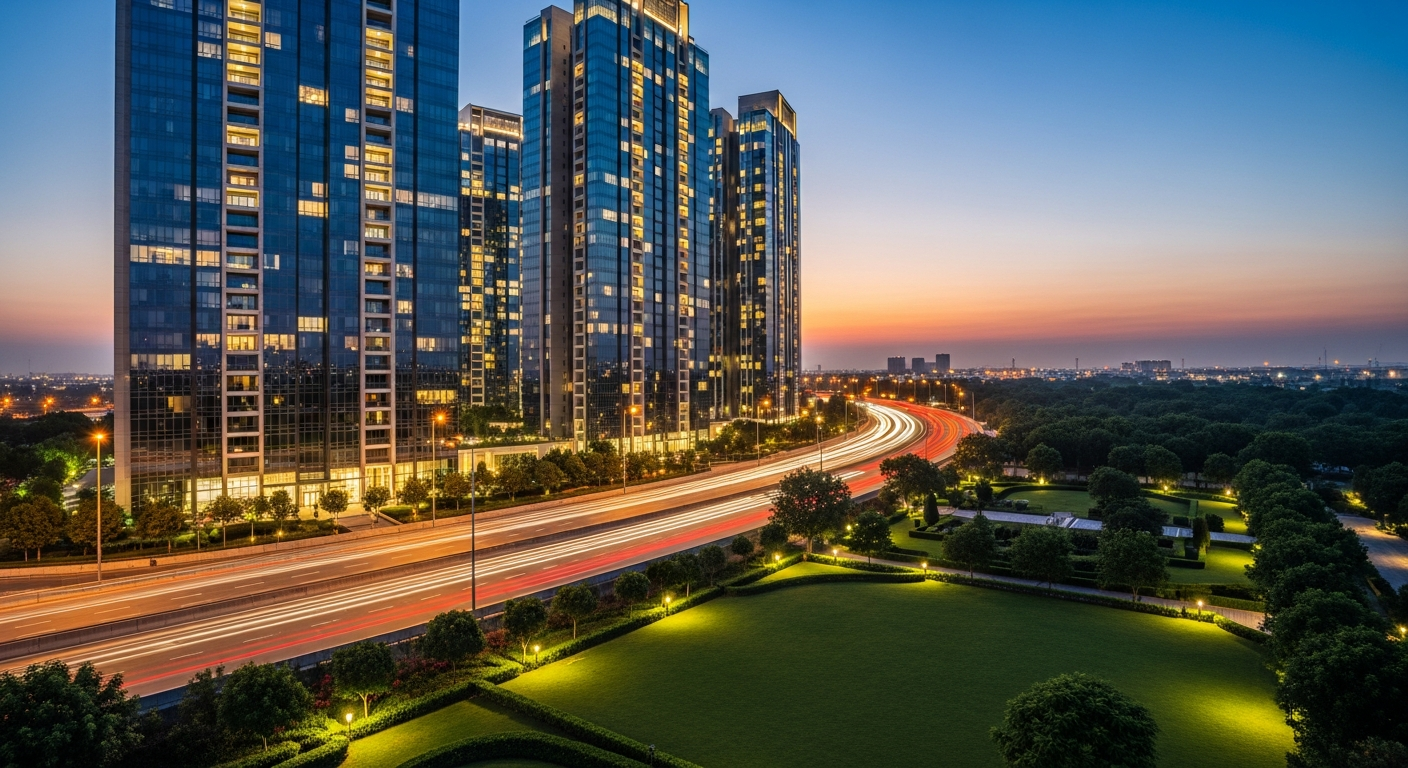
“A deep-dive institutional analysis of how the Rs 20 lakh crore national infrastructure plan will reshape Delhi-NCR's premium real estate corridors and how HNWIs can front-run institutional capital.”
The Indian infrastructure landscape is on the cusp of an unprecedented metamorphosis. The government’s monumental Rs 20 lakh crore capital outlay program is poised to fundamentally rewrite the valuation dynamics of the Delhi-NCR property market. For high-net-worth individuals (HNWIs) and institutional investors, this massive liquidity injection represents a once-in-a-decade window to acquire high-yield assets before the full integration of these multi-modal transit corridors triggers widespread yield compression.
Rather than a uniform rising tide, this capital deployment will create highly localized pockets of hyper-growth. Understanding the precise distribution of this capital across logistics, industrial, and transit corridors is the key to unlocking asymmetric returns.
🏗️ Deciphering the Capital Allocation & Timelines
The Rs 20 lakh crore master plan is not merely a budgetary allocation; it is a highly coordinated spatial development strategy. The capital is systematically distributed across three core pillars: multi-modal logistics parks (MMLPs), high-speed transit-oriented development (TOD) corridors, and industrial freight expressways.
The execution timeline is structured over a tight 3 to 7-year horizon, with immediate-phase allocations focusing on completing critical missing links in the regional rapid transit systems (RRTS) and peripheral expressways. This phased capital infusion ensures that liquidity enters the construction ecosystem systematically, preventing hyper-inflation while steadily driving up the intrinsic land value of adjacent micro-markets.
📍 The Micro-Market Heatmap: High-Yield Corridors
To front-run institutional capital, investors must look past generic regional labels and focus on specific micro-markets that will capture the highest multi-modal connectivity premium.
🚄 Greater Noida & Yamuna Expressway (YEIDA)
The Yamuna Expressway industrial zone is transitioning from a speculative land-banking destination into India's premier industrial and aviation gateway. The synergy between the upcoming Noida International Airport at Jewar, the integrated multi-modal cargo hub, and the Eastern Peripheral Expressway creates an unmatched logistics convergence. Commercial and industrial yields in this sector are projected to outpace traditional business districts as global manufacturing hubs establish their bases here.
🛣️ Dwarka Expressway & New Gurgaon
With the commercialization of the Dwarka Expressway, the physical integration between Delhi and Gurgaon is complete. However, the next leg of growth is driven by the planned integration with the Delhi-Mumbai Industrial Corridor (DMIC). This corridor is poised for a significant institutional shift, transition from high-end residential enclaves into corporate headquarters zones, mimicking the evolution of Phase 5 Golf Course Road over the past decade.
🏭 Sohna-SMR & Southern Peripheral Road (SPR)
Sohna is emerging as the ultimate dark horse of the NCR master plan. Positioned at the apex of the Delhi-Mumbai Expressway, this micro-market is receiving disproportionate capital allocations for logistics infrastructure and heavy industrial warehousing. HNWIs should focus on acquiring commercial-use land and pre-leased warehouse spaces in this zone, where rental yields are backed by multinational supply chain giants.
📈 The Multi-Modal Connectivity Premium: A Predictive Framework
To systematically evaluate investment opportunities within these corridors, PropVeda utilizes a proprietary predictive framework. The value of any property in the post-Rs 20 lakh crore era is directly proportional to its 'Multi-Modal Proximity Score' (MMPS).
This framework measures the distance of an asset from three critical touchpoints: a high-speed transit station (metro/RRTS), an express highway entry-exit ramp, and a dedicated freight/cargo terminal. Properties situated at the intersection of all three nodes command a permanent premium, insulating them from market volatility and ensuring consistent double-digit capital appreciation and high occupancies.
💼 Strategic Playbook: How to Front-Run Institutional Capital
Institutional private equity funds typically deploy capital during the post-stabilization phase of infrastructure projects. To maximize alpha, HNWIs must act during the intermediate development phase.
First, prioritize land aggregation and commercial plot acquisitions in the YEIDA and Sohna corridors. Second, pivot toward structured commercial developments along the Dwarka Expressway that offer immediate access to transit hubs. Finally, de-risk portfolios by focusing on Grade-A developers who have secured debt pipelines, ensuring project delivery aligns perfectly with public infrastructure completion timelines.
To navigate this complex landscape with institutional-grade precision, access our comprehensive, data-backed analysis. Visit PropVeda for the full forensic property report and secure your position in NCR’s highest-yielding corridors.
#DelhiNCRRealEstate #InfrastructureGrowth #WealthCreation #HNWIInvestment #PropTechIndia